

Want to get meaningful answers from your documents without reading them page by page? Tools like Sharly AI help professionals, researchers, and teams interact with PDFs and other files using AI-powered summaries and chat-style Q&A. Sharly lets you upload multiple formats, quickly understand dense content, and compare insights across documents in one workspace, making research and information retrieval smoother and faster.
At the same time, many users find themselves needing more than document insights — they want to build a dynamic knowledge base from multiple files, ask questions across them intelligently, and unlock practical outcomes from that information.
Knolli addresses these needs by enabling you to upload PDFs, Word docs, spreadsheets, and more, and then interact with all of them as connected knowledge hubs instead of isolated files. Knolli provides context-aware answers, multi-file interaction, and workspace organization that helps turn captured insights into real work results — from research synthesis to decision-making workflows and actionable outputs.
Here, we explore why Knolli can be a compelling Sharly AI alternative for users who want deeper context interaction with their documents while preserving the strengths that make Sharly effective for research and summarization.
Sharly AI is an AI-powered workspace built to help users understand, verify, and share insights from dense documents without heavy manual reading. It provides a secure environment where professionals — researchers, analysts, and teams can upload files and get structured, context-aware responses backed by their source material.
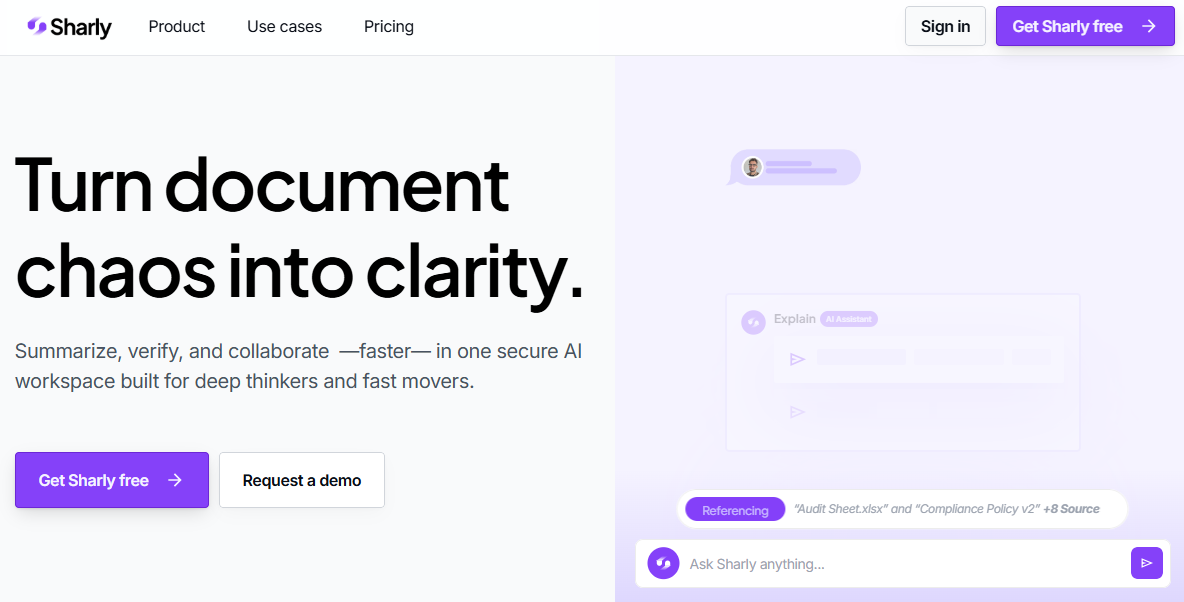
Here are Sharly’s core capabilities:
Sharly’s value lies in turning complex research materials into actionable insights while keeping source verification and shared understanding central to the workflow.
Sharly AI excels at turning complex documents into clear insights and structured summaries with source-backed answers.
However, as teams scale their work beyond understanding content, they may start to need more advanced capabilities that go beyond research-centric analysis and verification.
Here are some reasons organizations explore alternatives:
While Sharly focuses on extracting and comparing insights within and across uploaded documents, some workflows require broader integration with external data systems and live information sources — such as databases, spreadsheets, or CRM platforms — to build richer, actionable outputs.
Teams handling operational tasks, reporting, or actionable business deliverables often want to transform extracted insights into structured workflows
For example, turning PDF data into KPI dashboards, automated summaries across projects, or decision support dashboards. Sharly’s design prioritizes clarity and verification over building these kinds of integrated outputs.
Some teams demand tailored automations that fit precisely into their internal processes, such as custom AI agents, workflow triggers, and embedded interfaces. While Sharly supports collaborative and secure research spaces, it is not primarily positioned as a platform for building bespoke AI assistants or custom knowledge apps.
Organizations that want to turn document intelligence into a persistent internal knowledge base with evolving logic, reuse, and deployment into user-facing products may find themselves looking for solutions that combine document interaction with ongoing intelligence management and scaling features.
When users progress beyond insight extraction and research-oriented tasks, they often seek a platform that helps them operationalize knowledge, connect data sources, and create intelligent assistants tailored to real work needs.
Knolli’s core strength lies in transforming knowledge into interactive systems and automated workflows that go far beyond document & pdf summarization.
The platform enables teams to build AI copilots and agents that serve specific business functions — whether for internal teams, customer interaction, or specialized automation.
Knolli’s environment lets users define what they want their AI to do in plain language, then gives them tools to assemble, connect, and deploy those capabilities in a secure workspace. You don’t need to translate complex code into functional systems — instead, you configure intelligent assistants that reflect your information and workflow needs.
Unlike tools centered on summarizing documents in isolation, Knolli allows you to:
These design choices make Knolli particularly suitable when you want to operationalize what your organization knows, not simply understand it.
Knolli isn’t just a research tool — it’s a platform where knowledge becomes actionable, whether that’s:
All of this is designed to help teams move from insight to impact with fewer bottlenecks and less reliance on technical overhead.
To help you clearly see where each platform shines and how they differ in real-world use, here’s a comparison across key capabilities relevant to teams and professionals in 2026.
Imagine a product operations team at a mid-sized company preparing for a quarterly performance review and strategic planning cycle. This team needs to gather, interpret, and unify insights from a mix of financial reports, customer feedback summaries, operational dashboards, and compliance documents — all in a short span of time.
Outcome:
Sharly AI empowers the team to understand and verify information accurately, which is crucial for research and detailed review. Knolli helps the team translate understanding into outcomes with speed and clarity — reducing manual coordination and accelerating readiness for strategic decision-making.
In practical use, Sharly AI excels at helping teams uncover insights from dense documents with clarity, source verification, and structured synthesis across files, which is particularly valuable for research, academic work, compliance, and deep document analysis where accuracy and traceability matter.
In contrast, Knolli extends beyond insight extraction to help teams apply that understanding by building intelligent copilots that connect knowledge, data sources, and workflows into actionable results, empowering teams to ask questions, generate outputs, and automate steps without relying on technical overhead.
This makes Knolli especially suitable for professional environments where knowledge must not only be interpreted but also operationalized into real-world outcomes quickly and efficiently.
Try Knolli now and see the difference!!!
Knolli supports a wide range of file formats — including PDFs, Word docs, spreadsheets, text files, and more — so you can upload virtually any document and get instant, context-aware answers.
Yes. Knolli lets you create multi-document knowledge bases, enabling you to compare, summarize, and interact with several files simultaneously.
Knolli is a top alternative to Sharly AI. While Sharly AI focuses on summarizing, comparing, and extracting insights from research documents in a secure workspace, Knolli.ai provides powerful document interaction with context-aware Q&A and broader knowledge extraction across multiple file types, making it a strong choice for teams needing versatile AI support.
