

How can your enterprise use powerful AI models without exposing sensitive business data or compromising safety monitoring?
For organizations building AI copilots and autonomous agents, this creates a difficult balance. They need to protect confidential prompts, customer information, and internal workflows while allowing AI providers to detect misuse that may emerge across multiple interactions.
To address this challenge, OpenAI introduced Zero Data Retention (ZDR) with Private Safety Processing (PSP), a privacy-preserving approach that enables automated safety reviews without giving OpenAI personnel access to the underlying customer content. PSP was announced as a preview and is being rolled out to eligible API customers in phases.
However, ZDR with PSP does not mean all data disappears immediately. Selected encrypted interaction records must remain in customer-controlled storage for at least 30 days.
This article explains how OpenAI ZDR with PSP works, what data it retains, its security limitations, and what enterprises should consider before implementing it.
OpenAI Zero Data Retention (ZDR) with Private Safety Processing (PSP) is an API data-control approach that allows OpenAI to conduct automated safety reviews without retaining customer prompts and responses in its own standard monitoring logs.
The two mechanisms serve different purposes:
Together, they allow OpenAI to identify potential misuse while maintaining ZDR protections for eligible API customers.
Source: OpenAI API Data Controls. Eligibility, application-state retention, and documented exceptions vary by policy and endpoint.
The key distinction is that ZDR governs data retention, while PSP enables privacy-preserving safety monitoring. PSP adds storage and processing requirements that enterprises must evaluate alongside their existing security policies.
Traditional AI safety monitoring often evaluates individual prompts and responses. However, as AI models become more capable, potentially harmful activity may only become apparent across multiple interactions.
For example, a single prompt might appear harmless, while a sequence of related requests could reveal attempts to bypass safeguards or misuse an AI system. Detecting these patterns requires broader context, creating a challenge for organizations using Zero Data Retention (ZDR).
OpenAI introduced Private Safety Processing (PSP) to address this challenge without abandoning its ZDR commitments.
PSP enables OpenAI to:
The objective is to make safety monitoring compatible with stronger data-privacy requirements, rather than requiring enterprises to choose between the two.
Source: OpenAI - Offering Zero Data Retention for Frontier Models
OpenAI's Private Safety Processing (PSP) uses an asynchronous safety-review process to detect potential misuse while protecting customer data from human access.
Instead of retaining prompts and responses in standard abuse-monitoring logs, PSP encrypts selected interactions, stores them in customer-controlled cloud infrastructure, and analyzes them within a protected safety environment.
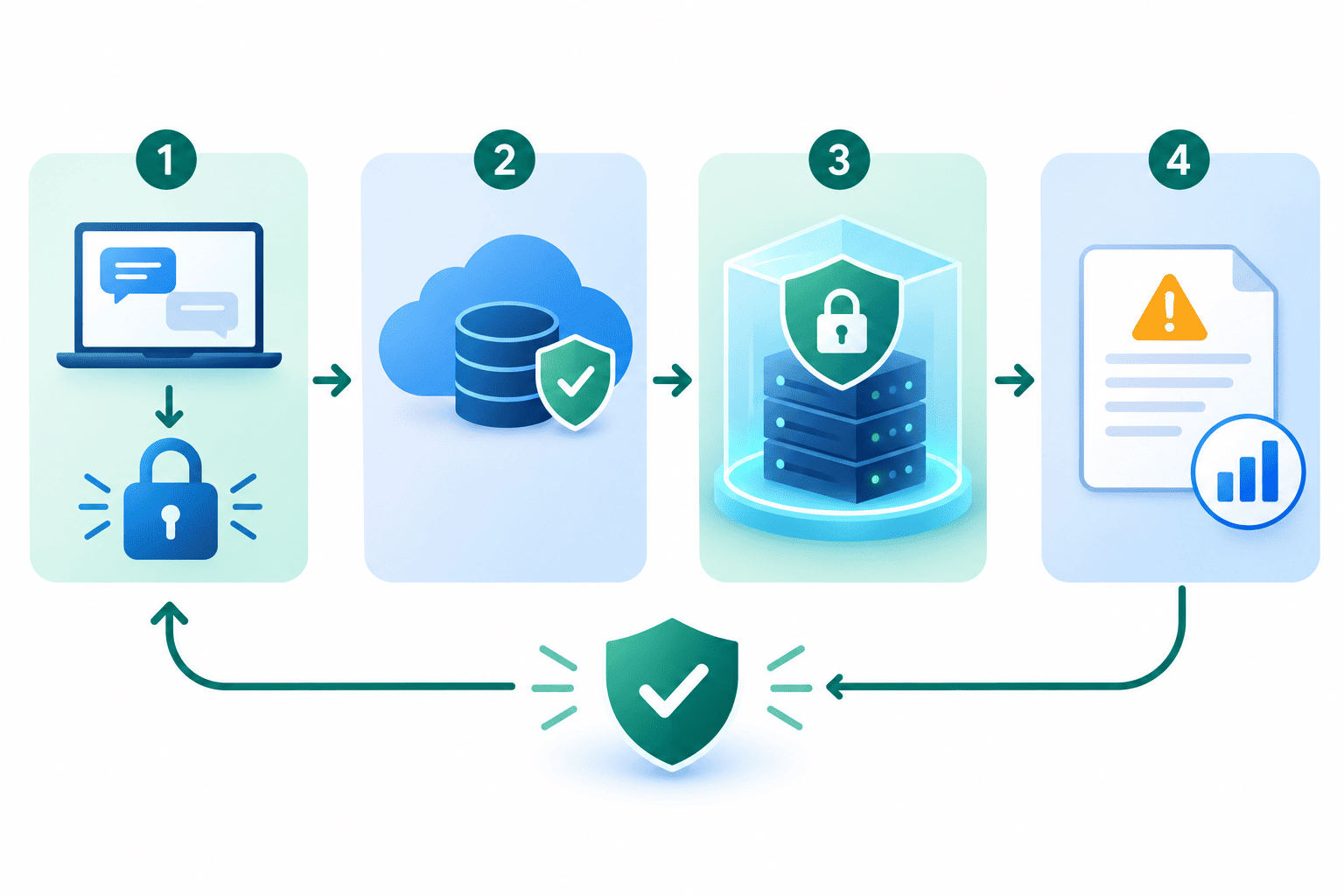
The process involves four steps.
When an application sends a request through an API project configured for ZDR with PSP, the model processes the prompt and generates a response.
An interaction may be selected for additional automated safety review through a safety-classifier referral or an approved sampling policy. A referral does not establish a policy violation.
Selected prompts and responses are encrypted before storage. Importantly, selection for review does not automatically indicate a policy violation.
Selected encrypted records are stored in the customer's configured cloud storage rather than OpenAI's standard abuse-monitoring logs.
PSP supports three cloud storage providers:
Customers must configure lifecycle rules so that encrypted records are not deleted before 30 days. OpenAI writes PSP records with a 30-day TTL, and customers must also ensure that the required storage permissions remain active.
When further analysis is necessary, PSP retrieves the encrypted records and processes them within a hardware-attested Safety Review Runtime.
This protected environment uses security controls designed to:
The review runs asynchronously, meaning the initial API response does not have to wait for the additional safety analysis.
After analyzing an interaction, PSP produces predefined safety signals and approved operational metadata instead of exposing full prompts or conversations.
These signals may indicate potential misuse and support subsequent safety decisions or enforcement. Detailed review results remain encrypted.
The key distinction: PSP enables OpenAI to evaluate safety risks across interactions without providing its personnel direct access to the sensitive content being reviewed.
For technical architecture and implementation details, refer to the official OpenAI PSP documentation.
Yes. OpenAI ZDR with PSP requires selected encrypted interaction records to remain in customer-controlled cloud storage for 30 days, even though OpenAI does not retain the underlying content in its standard abuse-monitoring logs.
This distinction is important because Zero Data Retention does not mean that no copies of customer data exist anywhere.
Under ZDR with PSP:
OpenAI uses two encryption layers to restrict access to retained safety records:
Revoking EKM authorization prevents further decryption of retained records, but it does not delete existing records or undo previously completed processing.
For enterprises, the key takeaway is that ZDR with PSP limits OpenAI's content retention and human access, but customers still need to manage storage, encryption permissions, and data lifecycle policies.
Source: OpenAI - ZDR with PSP Developer Documentation
Enabling OpenAI Zero Data Retention with Private Safety Processing requires more than selecting a privacy setting. Organizations must qualify for ZDR, configure supported cloud storage, and validate the connection before PSP becomes active.
OpenAI allows organizations already approved for ZDR to configure PSP through the API console or management API.
The setup involves four main steps:
Important: PSP applies to all API traffic within an enabled project, including requests to models that may not otherwise require PSP. Organizations that need different retention configurations should use configured projects separately.
ZDR with PSP does not automatically eliminate every form of data retention or apply identically to all OpenAI API capabilities.
Enterprises should account for the following limitations:
Before deployment, organizations should verify the supported models and endpoints, monitor storage health, and review their responsibilities under OpenAI's data-retention policies.
For configuration details and current restrictions, consult the OpenAI PSP setup guide and API data-controls documentation.
For enterprises building AI copilots and autonomous agents, OpenAI ZDR with PSP addresses data privacy and safety monitoring at the model-provider level. However, protecting sensitive information requires controls across the entire AI application, not just the underlying model.
Also read Lean4 & Knolli: Building Trustworthy & Scalable AI Copilots
An AI copilot may retrieve internal documents, connect to business applications, and exchange information across multiple models or tools. Even when an OpenAI API project uses ZDR with PSP, organizations must still consider:
Platforms such as Knolli help organizations manage AI applications beyond the model-provider layer.
Knolli helps enterprises build and orchestrate multi-model AI copilots and agents with role-based access controls and flexible deployment options, including private cloud and on-premises environments.
These capabilities give businesses more flexibility to design AI workflows around their data-access, infrastructure, and security requirements.
The distinction matters: OpenAI ZDR with PSP governs specific OpenAI API data-processing and safety-review practices, while Knolli helps enterprises manage the broader architecture in which AI models operate. Using Knolli does not automatically enable ZDR or PSP for connected OpenAI models.
For organizations evaluating secure AI deployment, explore Knolli's enterprise deployment options to understand how its capabilities can support your infrastructure requirements.
No. OpenAI does not use API customer data to train its models by default, unless the customer explicitly opts in. ZDR with PSP further restricts selected safety records to approved safety-processing purposes; they cannot be used to train models or be made available to other OpenAI groups or partners.
PSP produces predefined, bounded safety signals and approved operational metadata that may support subsequent safety decisions or enforcement. Detailed review results are encrypted before leaving the Safety Review Runtime and are stored in the customer’s cloud storage with the original record’s expiration.
ZDR and MAM are separate data-control policies. Approved customers select between ZDR and MAM at the organization or project level, so organizations should confirm which policy applies to each API project rather than assuming both operate simultaneously.
Storage failures, configuration problems, or revoked permissions can disrupt PSP safety-record delivery or retrieval. Organizations must restore access, correct configuration issues, and maintain the required storage and key-access configuration to meet PSP operational requirements. A runtime failure may not change the displayed storage status.
No. ZDR with PSP provides privacy-preserving safety controls but does not independently establish regulatory compliance. Organizations must evaluate data processing, access controls, contractual requirements, and other applicable obligations.
