

How do you choose between Microsoft-Decision-1 and Jev when both promise fast, accurate AI decisions, but differences in latency, confidence scores, and pricing could affect your application's performance?
Microsoft's launch of Microsoft-Decision-1 has introduced another option for developers building AI applications that require structured classification, scoring, and routing rather than lengthy generated responses.
Both Microsoft-Decision-1 and Jev are designed for decision-focused tasks, but choosing between them requires looking beyond advertised accuracy. Response speed, probability calibration, API compatibility, and deployment options can all influence how reliably and cost-effectively a model performs in production.
Microsoft-Decision-1 is a specialized decision-scoring model developed by Microsoft for applications that need fast, structured judgments. It was created by post-training Qwen3.5-9B for single-pass decision inference.
Unlike conventional large language models (LLMs), which generate text token by token, Microsoft-Decision-1 evaluates defined questions and returns numerical decisions that software can use directly.
It is designed for tasks such as intent classification, request routing, content filtering, incident prioritization, and AI response evaluation.
Microsoft-Decision-1 evaluates an input, called a state, against one or more predefined questions.
The state can contain text or JSON describing the information the model needs to assess. Each question specifies the decision to make and its expected output type.
Microsoft-Decision-1 supports three question types:
The model returns a structured decision with probabilities for the available categories. Application logic can then route the request to the appropriate team or escalate it if the probability is below a validated threshold.
Because Microsoft-Decision-1 produces typed numerical outputs rather than lengthy explanations, developers can integrate its decisions into existing software workflows without parsing free-form generated text.
However, the probability attached to a decision does not guarantee correctness. Thresholds should be tested using representative application data before automating consequential actions.
Microsoft-Decision-1 and Jev share a similar approach to structured decision-making.
Both accept contextual information and predefined questions, then return numerical results that applications can interpret programmatically.
Their core question types are also aligned:
The important distinction is that similar decision formats do not guarantee identical outputs or interchangeable APIs.
Microsoft-Decision-1 and Jev may assign different probabilities to the same input, produce different classifications, or behave differently when options are reworded.
Developers must also account for provider-specific endpoints, authentication, request parameters, and response handling when integrating either model.
Both models are designed to make structured decision-making more efficient than using a general-purpose LLM for suitable tasks.
However, their shared question types don't mean identical model behavior. Differences in accuracy, latency, probability calibration, pricing, and deployment requirements can affect which model is more suitable for production.
For developers evaluating alternatives to Jev, these distinctions provide a useful starting point before comparing published benchmarks and running application-specific tests.
Replacing Jev with Microsoft-Decision-1 requires changes to provider configuration and careful testing of existing application behavior.
Although their System One interfaces share a similar structure, successful migration depends on whether the new model produces reliable decisions under the application's existing rules, thresholds, and performance requirements.
Both models support the System One request pattern, but their API endpoints and deployment configurations differ.
Microsoft Foundry requires developers to reference their configured deployment name rather than assuming the underlying model identifier will work.
Therefore, an application using Jev cannot automatically switch to Microsoft-Decision-1 by changing only the model name. Its endpoint, credentials, and provider configuration must also be updated.
A controlled migration should cover five areas:
A model that accepts the same requests may still produce different results. Migration should therefore be approved based on application-specific tests rather than API compatibility alone.
Microsoft-Decision-1 achieved the highest overall accuracy in Microsoft's evaluation of 36 benchmarks covering nearly 150,000 questions. However, independent testing by AkitaOnRails found both Microsoft-Decision-1 and Jev achieved 97.6% accuracy on 168 compact classification cases.
The two evaluations used different methodologies. Microsoft's assessment covered diverse decision-making tasks, while AkitaOnRails tested synthetic classification and operational-policy scenarios in English and Brazilian Portuguese. The independent benchmark used predefined policies and published response archives, rather than an independently human-annotated evaluation set.
These results provide a basis for comparing accuracy, response time, probability calibration, and decision consistency, although performance may vary across applications.
Microsoft's official evaluation assessed routing, ranking, multilingual classification, long-context processing, reasoning, safety, and out-of-distribution performance. Microsoft-Decision-1 achieved the highest aggregate accuracy among the evaluated models, according to Microsoft.
The independent AkitaOnRails benchmark reported the following results:
Source: AkitaOnRails - Independent Decision Model Benchmark.
The models also made different mistakes despite achieving identical combined accuracy. This distinction matters when certain classification errors carry greater business consequences than others.
Microsoft reports that Microsoft-Decision-1 was approximately 2.5x faster than H2O-Lightning-4B v1.1 and delivered approximately 35x lower P50 latency than GPT-6 Sol in its official evaluation. These comparisons do not include a direct latency measurement against Jev.
AkitaOnRails measured the following median API response times:
Source: AkitaOnRails benchmark.
For latency-sensitive applications, these findings make provider-specific testing important, particularly when multiple decisions must execute sequentially.
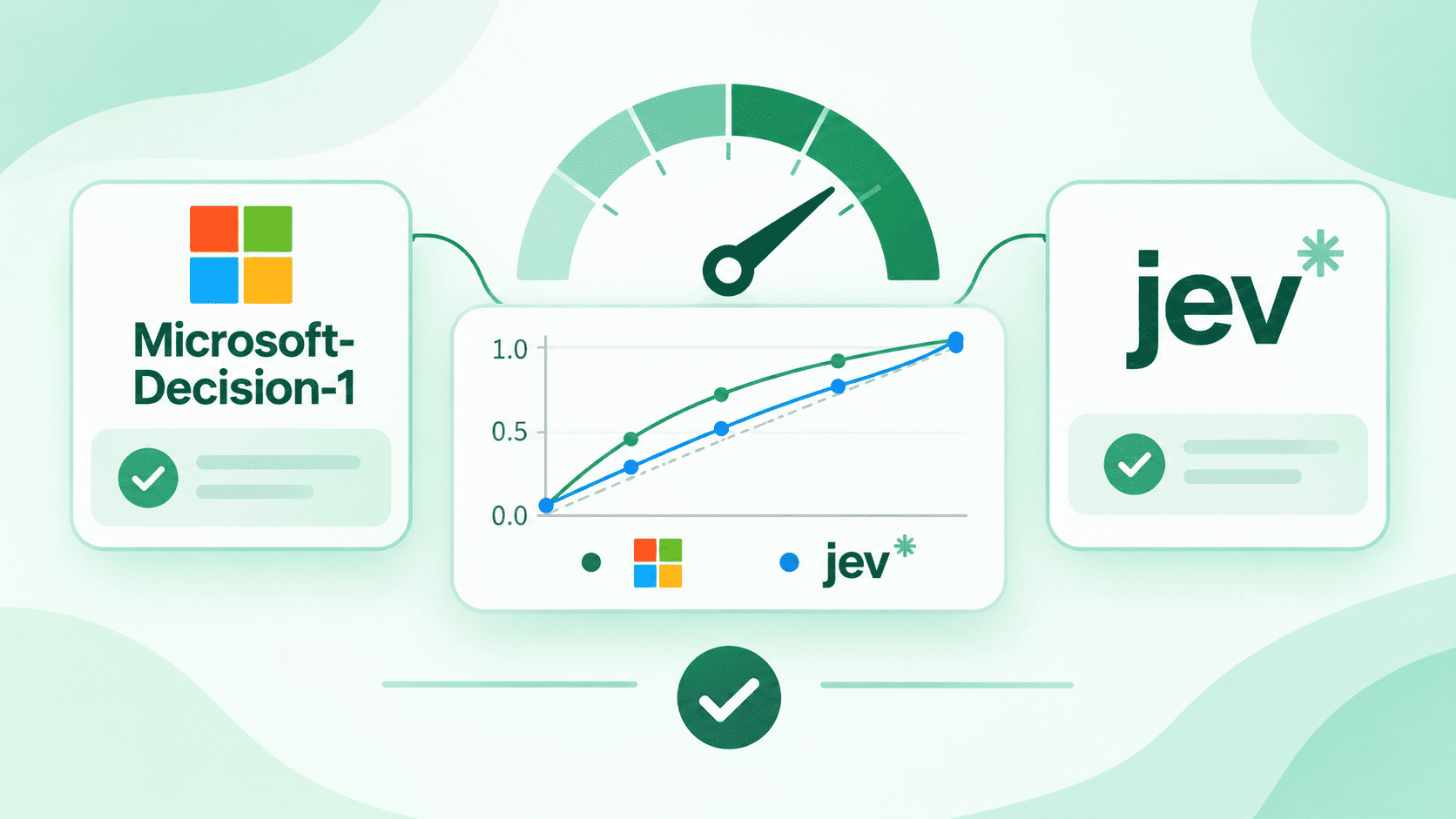
Probability calibration measures how closely a model's predicted probabilities match observed outcomes.
Microsoft evaluates Microsoft-Decision-1's calibration as part of its official benchmarks, while Jev uses TypeSafe AI's Reinforcement Learning for Calibrated Decisions (RLCD) training approach.
AkitaOnRails examined calibration using metrics including the Brier score and Expected Calibration Error (ECE).
In the compact classification tests, neither model made an incorrect prediction among responses assigned confidence above 90%. However, additional testing revealed limitations:
These findings demonstrate why classification accuracy and probability calibration must be assessed separately, particularly when confidence thresholds determine whether an application automatically approves, rejects, or escalates a decision.
Decision robustness measures whether harmless changes to an input affect the model's prediction.
Microsoft tested Microsoft-Decision-1 against eight types of perturbations, including paraphrased instructions, reordered options, modified keys, and formatting changes.
In its official evaluation, Microsoft-Decision-1 produced an average decision-flip rate of 1.3%. Microsoft also reported zero decision flips when answer options were reversed or shuffled, or when their descriptions were paraphrased.
AkitaOnRails separately tested how both models responded to altered option ordering, opaque category labels, and misleading reviewer comments.
Source: AkitaOnRails - Independent Decision Model Benchmark.
Because Microsoft's official and independent robustness tests used different datasets and evaluation methods, their results are not directly interchangeable.
The practical concern is whether small changes in wording, option labels, or irrelevant context cause inconsistent decisions. Applications that depend on stable classifications should test these variations against their own data before relying on automated outcomes.
Microsoft-Decision-1 and Jev are available through usage-based inference services, with published pricing of $0.042 per million input tokens and no separate output-token charge on supported providers.
However, identical token rates do not guarantee identical operating costs. Context limits, model versions, hosting arrangements, and data residency requirements can influence which model is more practical for production applications.
Microsoft-Decision-1 is priced at $0.042 per million input tokens on OpenRouter, with output tokens free. Jev 1.14 has the same published rate on OpenRouter, while DigitalOcean also lists usage-based pricing for Jev.
Sources: Microsoft-Decision-1 pricing, TypeSafe model pricing, and DigitalOcean Inference Pricing.
Actual costs may differ because of provider-specific billing, tokenization, request size, and additional applicable charges.
For applications processing several questions in one request, developers should also evaluate whether batching reduces repeated input processing and the resulting cost per decision.
Microsoft-Decision-1 is available through Microsoft Foundry and OpenRouter. Jev is accessible through TypeSafe AI, DigitalOcean Serverless Inference, and OpenRouter.
Their hosting arrangements introduce several practical differences.
Microsoft Foundry supports two deployment types for Microsoft-Decision-1:
These options allow organizations to select a deployment configuration based on their geographic processing requirements.
However, data-zone processing does not automatically establish compliance with every applicable data residency, storage, or regulatory requirement.
DigitalOcean provides access to Jev through its Serverless Inference service using a System One endpoint that passes requests through to TypeSafe AI.
Developers can use this service without provisioning their own GPU infrastructure.
Organizations should review DigitalOcean's current Inference documentation and data-processing terms before assuming EU data residency or other regional processing guarantees. Organizations with geographic restrictions should also review the data-processing arrangements of any other Jev provider they intend to use.
Context Window and Model Version Availability
Context limits can also affect deployment suitability, especially when applications evaluate long documents or large collections of decision criteria.
Sources: Microsoft-Decision-1 model listing and OpenRouter's Jev documentation.
These limits are provider- and configuration-dependent. In particular, Jev's standard request allowance should not be confused with the maximum permitted length of its state or an individual question, and OpenRouter's listed context window may differ from the limits enforced by another provider.
Model versions can vary by provider. OpenRouter lists Jev 1.14 as the latest version as of October 2026; developers should confirm the exact Jev version exposed by their chosen provider, including DigitalOcean, before integration.
Developers should verify the available model version and context configuration when choosing an inference provider.
Neither Microsoft-Decision-1 nor Jev has a publicly downloadable model-weight release verified in the reviewed official documentation.
Although Microsoft-Decision-1 was developed by post-training Qwen3.5-9B, the availability or license of that underlying model does not automatically apply to Microsoft's specialized Decision-1 model weights.
Jev is similarly offered as a proprietary decision model through managed API services.
Microsoft Foundry's managed deployment controls do not mean developers receive the underlying model weights or can independently operate them on private hardware.
Similarly, accessing Jev through DigitalOcean or OpenRouter does not establish independent hosting or modification rights.
Organizations requiring on-premises inference, privately managed GPUs, or custom model modifications should confirm the applicable licensing and deployment permissions directly with the model provider before making an infrastructure commitment.
Microsoft-Decision-1 and Jev can support AI applications that need structured decisions for routing, classification, relevance evaluation, and workflow control. Here are five practical use cases where developers can evaluate their capabilities.
AI applications often use specialized agents for different tasks. Selecting the wrong agent can waste processing resources and reduce response quality.
Microsoft-Decision-1 and Jev can classify incoming requests and identify the most suitable agent or tool from predefined options.
The decision model recommends the destination, while the orchestration system manages execution and permissions.
Retrieval-augmented generation (RAG) systems sometimes retrieve documents that match a query semantically but do not contain useful information.
Decision models can evaluate retrieved passages against a user's question and assign relevance scores.
The RAG pipeline can then prioritize useful passages before passing them to a generative model. However, relevance scoring does not independently verify factual accuracy or document permissions.
Support teams must distinguish routine inquiries from issues requiring immediate attention.
Microsoft-Decision-1 and Jev can classify tickets by issue type and assess urgency against predefined criteria.
The support system can use the results to organize queues and trigger appropriate escalation rules. Operational data, such as actual service outages and affected customers, should also inform priority decisions.
AI-generated responses can appear convincing while failing to follow instructions or meet specific requirements.
Microsoft-Decision-1 and Jev can evaluate responses against defined criteria, such as relevance, completeness, and adherence to response guidelines.
The application can then accept the response, request revision, or send it for review. Factual verification may still require additional evidence checks.
Automated applications need rules for determining when a decision requires additional review.
Microsoft-Decision-1 and Jev can evaluate information and provide probability scores that help inform those rules.
The application may proceed when required fields pass validation, request missing details, or escalate uncertain cases to a human reviewer.
For sensitive decisions, model probabilities should support, not replace, deterministic validation and appropriate human oversight.
Microsoft-Decision-1 and Jev are designed for structured decision-making, but they cannot independently handle every requirement of a production AI system. Developers should consider the following limitations before relying on either model.
Neither model is intended to generate detailed explanations, summarize documents, or produce conversational responses.
Microsoft-Decision-1 returns predefined answers with calibrated probability scores rather than written rationales, while Jev focuses on typed System One decision outputs.
Applications requiring complex explanations, content creation, or multi-step reasoning still need a generative LLM or other supporting components.
A high probability score does not prove that a prediction is correct, particularly when a model encounters unfamiliar inputs.
Microsoft acknowledges that calibration may be less reliable on tasks outside familiar patterns. Jev's emphasis on calibrated decisions does not eliminate this general limitation.
Developers should establish decision thresholds using representative data and avoid relying solely on model confidence for consequential actions.
Both models depend on the context, instructions, and answer options supplied by the application.
Ambiguous labels, incomplete information, or poorly defined criteria can lead to misleading decisions even when the API returns a valid response.
Microsoft specifically warns that question wording and option ordering can influence results. Clear evaluation criteria and an explicit "cannot determine" option can help reduce forced classifications.
Microsoft-Decision-1 and Jev both offer efficient, structured AI decision-making, but the better choice depends on your application.
Microsoft-Decision-1 is a strong option for organizations using Microsoft Foundry, while Jev offers competitive accuracy and lower median latency in the cited independent API tests. Consider your deployment requirements, decision reliability, and operating costs before choosing.
Choosing a decision model is just the beginning. Knolli helps businesses turn their knowledge into AI-powered applications and intelligent workflows. Explore Knolli to build practical AI solutions tailored to your business needs.
Microsoft-Decision-1 leads Microsoft's official benchmark evaluation, but independent testing found both models achieved 97.6% accuracy on 168 compact classification cases. Performance varies by task and dataset.
In independent API testing, Jev recorded 255 ms median latency compared with 422 ms for Microsoft-Decision-1. Results may vary by hosting provider and workload.
Neither model consistently demonstrates superior calibration across all tasks. Both produce probability scores, but their reliability depends on the input data and evaluation conditions.
Both support similar System One request structures, but switching requires endpoint, authentication, and configuration changes. Existing decision logic should also be tested.
Both models can classify requests and help select appropriate AI agents. The better choice depends on routing accuracy, response time, cost, and integration requirements.
