

Are AI automation platforms enough on their own, or do growing businesses need tools that also support real financial and strategic decisions?
AI adoption across businesses has increased over the past few years. According to McKinsey’s latest global AI survey, 88% of organizations now use AI in at least one business function, a nearly 10% increase in adoption rate from the previous year.
(Source)
Gartner also reports that more than 80% of enterprises will use generative AI APIs or deploy generative AI-enabled applications by 2026. It clearly indicates how deeply AI is becoming part of everyday business systems rather than remaining experimental.
(Source)
Platforms like Assistents.ai play an important role in this shift. They help teams to create:
For many teams, this approach
As companies grow, however, many leaders start looking for tools that go a step further. Founders, CFOs, and finance teams often need help understanding performance, forecasting outcomes, and preparing clear updates for stakeholders. Automation alone does not always provide these answers.
Knolli.ai is built to support this next stage. It focuses on turning business and financial data into clear insights, scenario analysis, and ready-to-share outputs such as summaries and reports.
By helping teams understand what the numbers mean and what actions to take, Knolli.ai supports faster and more confident decision-making.
In the next section, we’ll take a closer look at what Assistents.ai offers and how teams commonly use it today.
Assistents.ai is a platform that helps businesses build custom AI assistants and AI tools geared toward automating tasks and retrieving information from internal sources. It allows users to describe what they need in plain language and quickly create solutions that leverage their company’s own data.
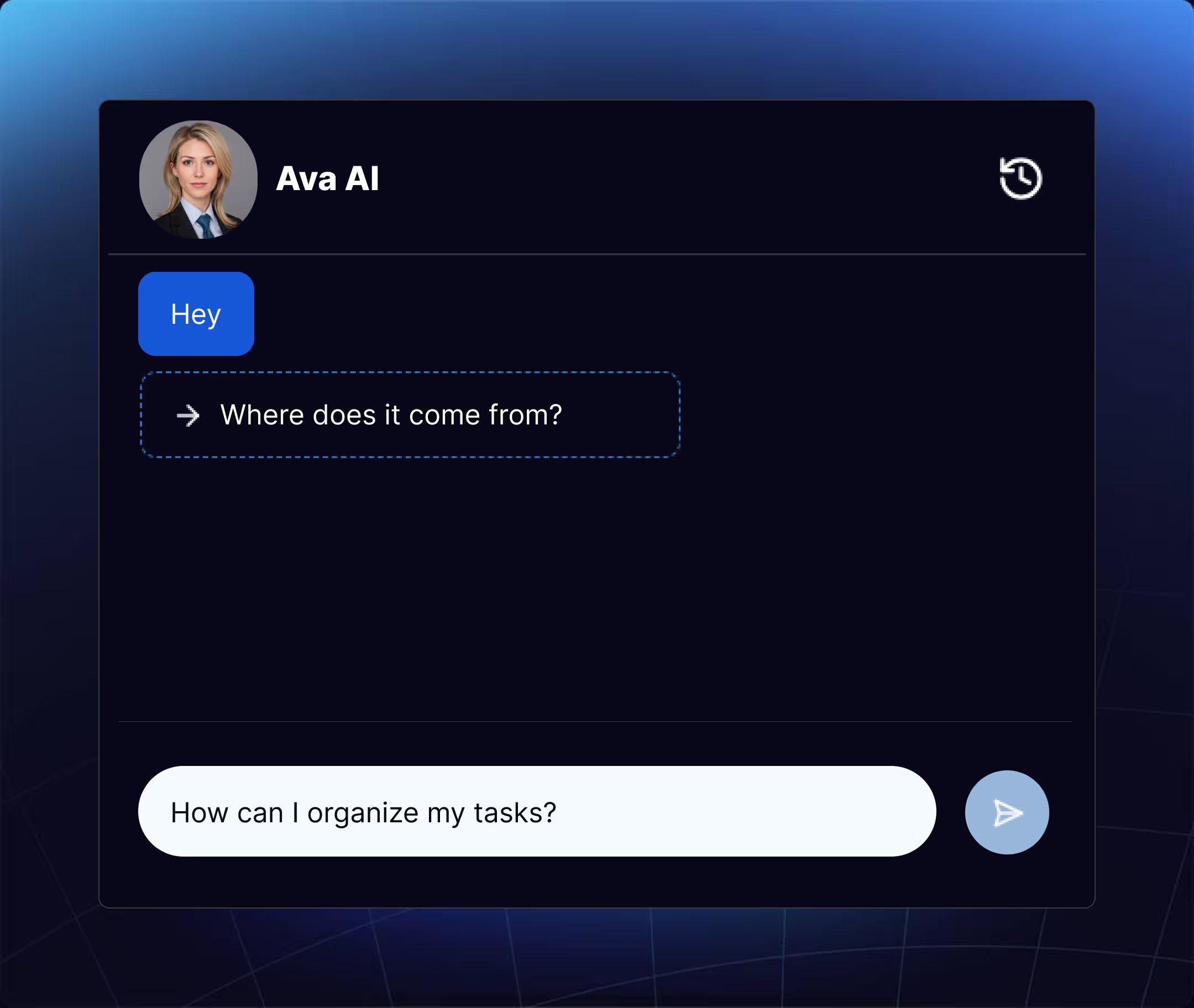
While platforms like Assistents.ai help companies automate tasks and build custom AI assistants, some teams find that their needs grow beyond task execution and basic automation.
In many businesses like finance and planning, leaders require tools that do more than just move data — they need tools that help them understand what the data means and how it affects outcomes.
In practice, an AI agent or assistant is excellent at carrying out specific, instruction-based tasks, but it may not always provide additional insights or context without clear human direction. Research into AI agents highlights an ongoing challenge with maintaining context over complex or extended tasks, which can affect how accurately these systems support multi-step workflows or decisions over time.
Furthermore, general AI assistants often need well-defined prompts and human guidance to complete tasks, and they may not act independently beyond those instructions. This can limit their usefulness when tools are expected to analyze patterns, interpret business results, or generate strategic summaries that support higher-level decisions.
As a result, some teams begin exploring alternatives that integrate both automation and decision support, offering visual summaries, scenario simulations, and business performance insights alongside task automation.
These alternatives are especially appealing to leaders who want to spend less time preparing reports and more time acting on meaningful results.
When teams move beyond basic automation and require tools that not only perform tasks but also convert knowledge into usable business solutions, they often seek platforms that let them build AI copilots tailored to their domain, workflows, and audience.
Knolli.ai is one such platform that helps organizations do exactly this by turning internal knowledge and data into intelligent assistants that support broader use cases beyond simple task execution.
Knolli.ai lets teams create custom AI copilots, using a single interface to upload documents, connect data sources, and configure assistants that can interact with users or team members in meaningful ways.
This makes it easier for businesses to surface their expertise, automate responses, and provide contextual support that aligns with their goals.
Unlike tools that primarily focus on moving data or executing predefined actions, Knolli.ai supports knowledge-driven interactions where uploaded content like guides, FAQs, datasets, and proprietary information becomes part of the assistant’s intelligence.
These copilots can be deployed across websites, internal tools, messaging platforms, and other environments where users need helpful, accurate, context-aware responses.
Knolli.ai also offers advanced capabilities such as multi-agent architecture, analytics dashboards, customization options, and integrations with common business systems, enabling teams to tailor experiences for different departments, such as sales, support, or knowledge management.
A finance lead uses Assistents.ai to set up agents that pull data and run task sequences across connected apps. The platform automates task execution, but the team still needs to manually interpret the results, craft narratives, and assemble reports for stakeholders. Each month requires human effort to turn raw outputs into actionable summaries.
The same lead uploads business data into Knolli.ai or links their sources. Knolli.ai automatically extracts key metrics, highlights trends, and creates a clear narrative summary. This structured output is ready to share with leadership without repetitive manual writing. What once took hours now takes just a few steps, with both insight and explanation delivered together.
In simple terms, when teams start with tools like Assistents.ai to automate tasks and connect systems, they often reduce repetitive work across apps and workflows without heavy manual effort.
But as businesses look for tools that can also interpret data and provide clear insights from knowledge and internal content, they begin to explore alternatives built for both automation and understanding.
Knolli.ai helps teams turn business documents and datasets into custom AI copilots that can answer questions, summarize key information, and deliver useful insights in a way that sounds natural and actionable — so leaders spend less time preparing reports and more time using information to make decisions.
