
Are you spending too much time switching between AI tools without knowing which ones actually move your startup forward?
The best AI tools for startups in 2026 are those that solve distinct business problems without adding unnecessary cost or complexity. Instead of paying for dozens of overlapping subscriptions, startups need a focused AI stack for product development, AI copilots and agents, market research, marketing, content creation, video production, and sales.
This guide compares CodeConductor, Knolli, v0 by Vercel, Perplexity AI, Jasper, Runway, and Pipedrive AI CRM based on the startup use case each tool is best suited for.
The best AI tool for a startup depends on the problem it needs to solve. The following tools cover different stages of the startup journey, from product development and AI automation to research, marketing, creative production, and sales.
CodeConductor is an AI development tool for startups that need to move beyond an early prototype and build a production-ready web or mobile product. It combines full-stack application development with deployment and infrastructure workflows, making it particularly relevant for SaaS startups building their first scalable product.
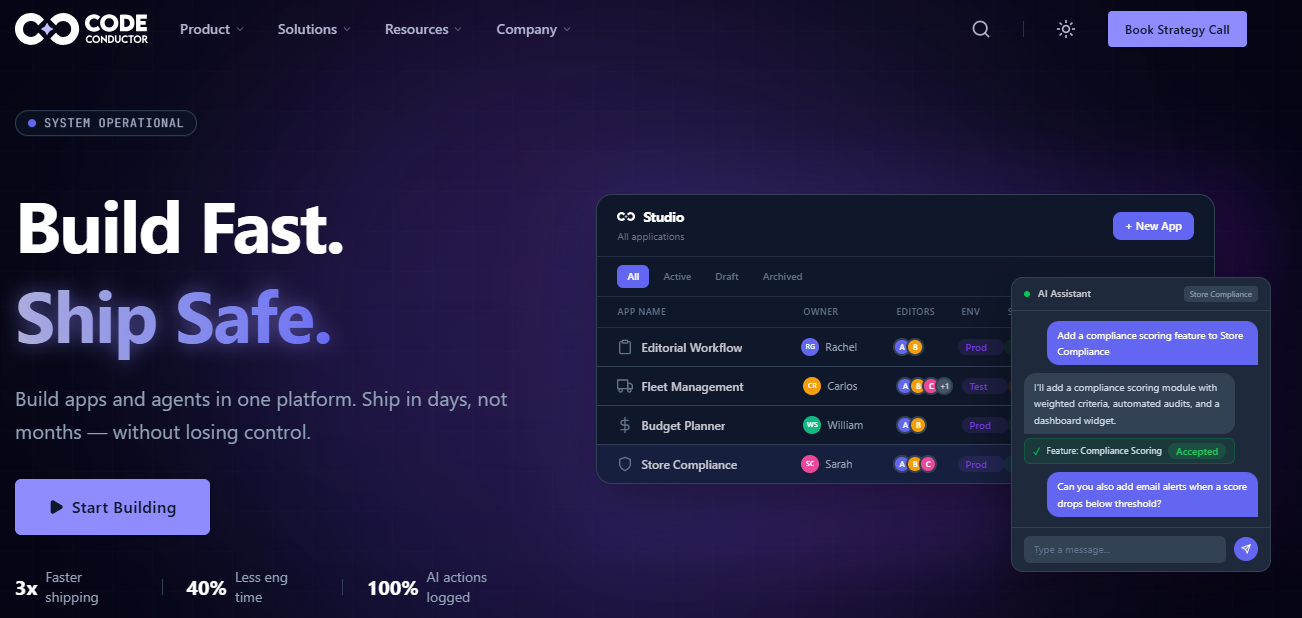
Startups can use CodeConductor to:
For an early-stage SaaS startup, CodeConductor becomes most useful once the idea has been validated and the team needs to turn product requirements into a working application that can be deployed and maintained.
Best for: SaaS startups and product teams building or scaling production-ready web and mobile applications.
Knolli is a low-code AI platform for SaaS startups and founders that want to create, launch, and monetize AI copilots and agents powered by their own knowledge. It provides a single workspace for building AI experiences without having to assemble separate tools for knowledge, workflows, deployment, and monetization.
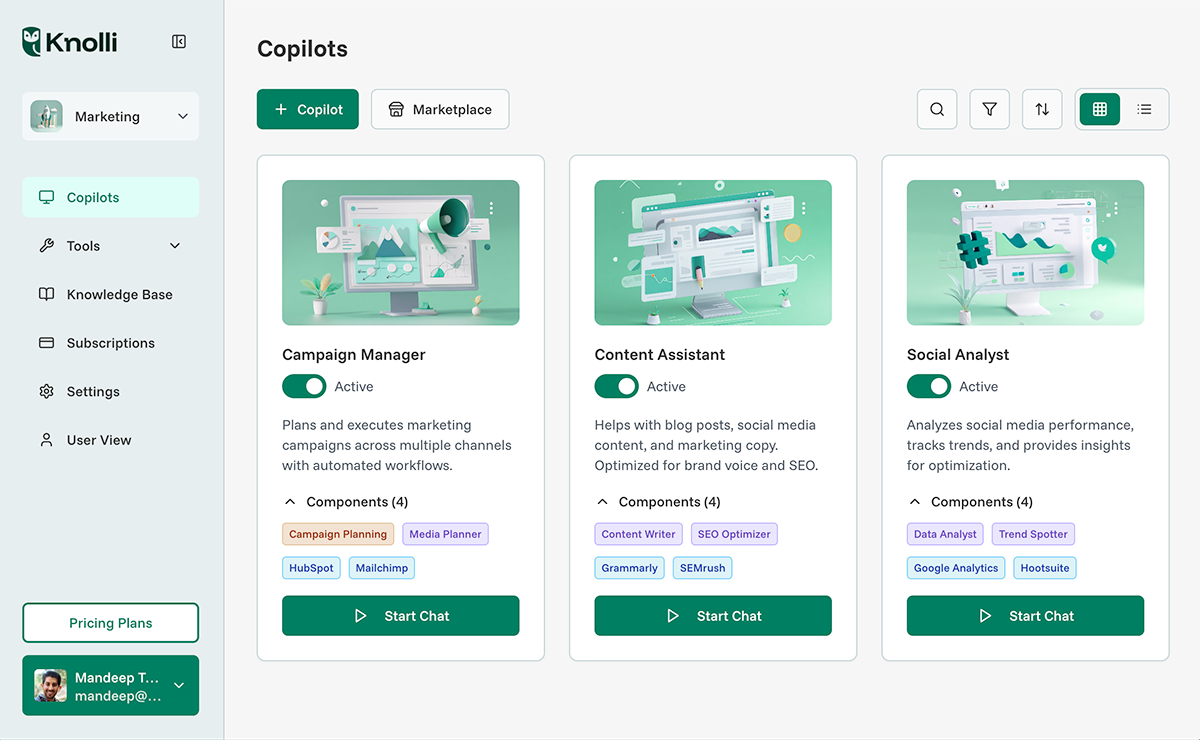
Startups can use Knolli to:
For example, a SaaS startup could build a customer onboarding copilot trained on its product documentation to answer product questions and guide customers through common onboarding tasks.
Best for: SaaS startups and founders looking for a low-code AI tool to turn proprietary knowledge or workflows into customer-facing or internal AI copilots and agents.
v0 by Vercel is an AI app builder and coding agent that helps startups turn product ideas into working web applications using natural-language prompts. It can generate full-stack applications, preview changes in real time, connect external services, and deploy directly to Vercel.
Startups can use v0 to:
For early-stage teams, v0 is useful when the goal is to move quickly from an idea to a functional application that can be tested, refined, and shared with users.
Best for: Startups looking for an AI app builder for rapid prototyping, MVP development, and full-stack web application creation.
Perplexity AI is an AI market research and search tool that helps startups investigate competitors, markets, and industry trends using current web information with cited sources. It is useful for founders who need to gather and compare information quickly before making product or go-to-market decisions.
Startups can use Perplexity to:
For example, a SaaS founder could use Perplexity to compare competing products and assess a market before deciding how to position a new offering.
Best for: Startup founders and SaaS teams looking for an AI research tool for market analysis, competitor research, and industry intelligence.
AI research should support, not replace, customer interviews, firsthand user feedback, or primary market validation.
Jasper is an AI marketing platform that helps startup teams create consistent, on-brand content across campaigns and channels. It combines brand context with marketing-focused AI tools and agents, making it useful when content production starts growing beyond one-off prompts.
Startups can use Jasper to:
For a growing SaaS startup, Jasper can help a small marketing team produce more campaign content without losing consistency in tone and messaging.
Best for: Startups looking for an AI marketing tool for brand-consistent content and multi-channel campaign execution.
Runway is an AI video creation tool that startups can use to generate and edit visual content for marketing campaigns, product launches, and social media. Its Gen-4.5 model supports text-to-video generation, with image-to-video now also available.
Startups can use Runway to:
For startups with limited video-production resources, Runway provides a practical way to create and experiment with visual content.
Best for: Startups looking for an AI video creation tool for marketing content, product visuals, and creative experimentation.
Pipedrive is a sales CRM with AI-assisted features that helps startups manage leads, deals, follow-ups, and sales pipeline activity in one place. Its visual pipeline makes it easier to track opportunities by stage, while AI-assisted report creation helps teams build reports from CRM data.
Startups can use Pipedrive to:
For a founder-led B2B SaaS startup, Pipedrive can provide a more structured way to manage prospects as the sales pipeline grows beyond spreadsheets.
Best for: Startups looking for a sales CRM for lead management, pipeline tracking, follow-ups, and AI-assisted reporting.
The best AI tools for startups are not necessarily the ones with the most features. They are the ones that solve a clear business problem without adding unnecessary cost, overlap, or complexity.
Choose tools based on what your startup needs now, whether that is product development, AI capabilities, market research, marketing, video creation, or sales. As your team grows, review your stack regularly and remove tools that are no longer delivering clear value.
AI can help startups move faster, but it works best when it supports human judgment rather than replacing it.
If AI is becoming part of your SaaS startup’s product or customer experience, Knolli provides a low-code way to build AI copilots and agents around your own knowledge, workflows, and integrations.
AI tools for startups are software platforms that use artificial intelligence to support tasks such as product development, research, marketing, content creation, automation, customer support, and sales.
AI can reduce manual work, speed up repetitive tasks, and help small teams handle more work without immediately expanding headcount or adding multiple specialized tools.
Yes. Many AI platforms offer free plans, trials, or usage-based tiers. Startups should compare limits, required features, and upgrade costs before building important workflows around a free plan.
AI tools can help startups move faster with smaller teams by supporting research, product development, marketing, sales, and operations. The best results come from using AI for specific, measurable business needs.
Security varies by provider. Startups should review data retention, model-training policies, access controls, encryption, integrations, and compliance requirements before sharing sensitive customer or company data.
AI tools can automate repetitive, rule-based tasks like lead follow-ups, email and social scheduling, content drafting, data entry, report generation, and routine customer support.
AI tools can automate parts of a role, but they do not eliminate the need for human judgment, strategy, creativity, and accountability. Startups should use AI to augment teams rather than assume it can replace entire functions.
